Blog

Cap and Trade
The Proposal
Congress has proposed legislation (HR 2454) with the intent to create clean energy jobs, achieve energy independence, reduce global warming pollution and transition to a clean energy economy. This bill is known as "Cap and Trade". To accomplish this HR 2454 will enact the first national limits on the amount of greenhouse gases emitted by power plants, refineries and factories. Basically this bill puts a price on pollution. The Cap and Trade bill will raise the cost for companies to continue to use fuels that contribute to global warming. This bill hopes to present companies with an incentive to reduce their pollutants and encourage them to seek cleaner alternatives. However a transition of this magnitude will cause many changes in the energy market, and whether they are for the better or worse remains to be seen.
The primary goal of the Cap and Trade bill is to limit carbon dioxide emissions, a greenhouse gas which is thought to cause global warming. Whether or not global warming (or even cooling as seen in the past year) is occuring is not going to be discussed here. We will only remind our readers that CO2 is needed for plant life and accounts for only 0.038% of our atmosphere. Man's activity contributes only 3% of the CO2 in our atmosphere and pales in comparison to the CO2 emitted from a major volcano erruption.
The 1,427 page watershed bill sponsored by Representatives Waxman/Markey passed the House on June 26, 2009 with less than 24 hours debate. It is now in the Senate where it will hopefully undergo more scrutiny.
Implementation
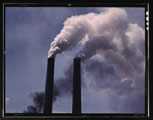
Setting limits on emissions is the first step or the "Cap" part of the bill. Over time this cap will be lowered to allow less and less emissions. Companies and facilities will be given permits for their share of carbon emissions, an annual pollution allowance. At first, most permits would be given without charge, to help ease into the new plan. However there will be a limited supply of these permits, and they will eventually gain value.
Companies whose emissions exceed their allowance have three options.
1. The first option is to find ways to reduce their emissions.
2. The second option is to buy more credits from a company with leftover credits. This kind of interaction makes up the "Trade" portion of the bill.
3. A third option is for companies to invest in pollution reductions made elsewhere, such as farms that capture methane or plant trees, known as offsets. Companies will naturally pick the cheapest option.
The Costs
The pros and cons of such a bill are still difficult to measure, and there are strong feelings on either side. Some say this is exactly the stimulus the green energy market needs, and that this legislation will greatly reduce air pollution. Others argue that the proposed actions are misguided. Opponents claim they interfere with free markets and force our domestic oil, natural gas and coal industries to subsidize their own destruction.
The Congressional Budget Offices has admitted that it will be very difficult to estimate the costs of this massive undertaking. We do know that major environmental groups have already spent more than $10 million on ads supporting the legislation. We also know that a great deal of tax dollars will be used to set up the "Cap and Trade" market and then to provide ongoing regulation. In his election campaign, President Obama freely admitted that cap and trade was a high priority and it would necessarily cause electric rates to sky-rocket.
The well-respected Heritage Group had this to say. "The allowances created by Waxman-Markey to restrain CO2 emissions do not create economic value, which is another way of saying that the allowances do not improve the material well-being of Americans. Instead, they are a form of taxation and will be one of the largest taxes collected by the federal government. This tax created by Waxman-Markey will collect $5.7 trillion over the period 2012 to 2035 - at a cost of thousands of dollars per year per family." Heritage's analysis predicts these energy cost increases by the year 2035: gasoline 58%, natural gas 55%, heating oil 56% and electricity 90%.
Source: Heritage Center for Data Analysis -August 2009
The bill, by dictating the places from which energy can be purchased, would provide yet another blow to the struggling economies of midwestern states. It does this by mandating winners and losers by providing direct subsidies to select sources of fuel. Notice from this map how the home states of Waxman (California) and Markey (Massachuesetts) are in the handful of states that would benefit from this legislation. Contact Independent Energy Consultants if you would like help tracking your company's greenhouse gas emissions or to purchase renewal energy.
Channel Partners And Associations