Green Energy Initiatives
Green Industry Background and Definitions
With all the talk of global warming and earth day festivities still fresh in our minds, we would like to highlight the many ways in which Independent Energy Consultants can help your company become a better environmental steward. Regardless of your thoughts on whether or not global warming is occurring, if man is contributing to it, if mankind can do anything about it, or even if it's bad for our environment; it is good business to understand your options, remain in compliance with state and federal regulations and consider developing a strategic response corporate wide. Let's begin our discussion with some background information and a few key definitions.
If Global Warming is truly occurring on our planet, the cause is believed to be a buildup of Greenhouse Gases (GHGs). These gases get their name from the greenhouse effect they are believed to cause. As the sun warms our planet the heat is naturally released back into space. The GHGs, however, trap some of the heat and has a warming effect on the planet. It is important to note that GHGs occur naturally and through human activity. The promulgation of environmental rules in the U.S. and worldwide are attempting to reduce the concentration of GHGs by creating penalties and/or incentives that will modify our behavior. These rules focus on the following six (6) GHGs that are believed to be contributing to global warming. According to World Resource Institute, March 2008, here are the major manmade sources of GHG and their percentage contribution.
Carbon dioxide (CO2) - Deforestation, burning fossil fuels 73.5%,
Methane (CH4)- Natural gas, landfills, animal waste and coal mines 16.8%,
Nitrous Oxide (NO2)- Fertilizers, automobiles, sewage 8.7%,
Hydrofluorocarbons (HFCs) - Air conditioners, refrigerators 0.7%,
Perfluorocarbons (PFCs) - Aluminum production, semiconductor manufacturing 0.2%, and
Sulfur hexafluoride (SF6)- Electrical power systems, electronics manufacturing 0.1%.
Green Power - electricity generated from one of the following general categories of renewable resources: Wind, solar, wave, tidal, hydro, geothermal and biomass. (Note: Nuclear power plants emit zero GHG emissions but are excluded from the list, as is hydro in some instances, due to their other environmental impacts.)
Brown Power - electricity generated from non- renewable resources such as coal, natural gas, oil and nuclear.
Renewable Energy Certificates (RECs) - represents the environmental and other non-electrical attributes associated with 1 MWh (megawatt-hour) of electricity generated from renewable resources. Each MWh of electricity produced by a renewable source displaces 1 MWh of electricity from a brown source. RECs are financially traded products available to anyone wishing to support renewable power sources and limit GHG emissions.
Green Energy Sourcing
As a Channel Partner of WorldEnergy Solutions we are able to source green power directly from renewable resources, and/or source RECs as part of a separate auction. Let's look at RECs and why they are becoming so popular with those wanting to green their energy portfolio.
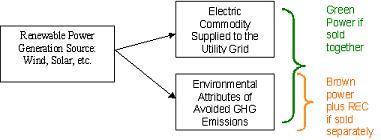
The diagram above shows the following:
If an end-user buys electricity directly from a renewable source generator they are buying green power. That includes the actual electric commodity and the environmental benefits of the green power. Remember, for each MWh of green power that is generated, one MWh of brown power is displaced.
Conversely, an end-user may purchase RECs separately from the actual electric commodity. In that case the environmental benefit stays with the REC and electricity flows to the grid undistinguishable from brown power.
Since RECs are sold separately from the underlying electricity, they can offer these advantages:
- Lower cost. REC prices plus brown power, often cost less than the typical bundled cost per MWh charged by a retail supplier of green power.
- Geographical boundaries are eliminated. For example, a customer can purchase RECs from wind farms operating in the Plains or wind farms in the Northeast. Often the former is less expensive due to better wind conditions.
- More suppliers to choose from. Once again, since geographical boundaries are eliminated, the laws of physics that limit electricity flow aren't an issue.
- Simplified transactions. RECs don't further complicate electricity purchases. Corporations can also purchase RECs and apply them to hundreds of facilities in a single transaction, as opposed to buying green power via individual contracts. Purchasing RECs is also much easier than attempting to contract directly with a green power generator.
- You control timing and quantity. Unlike electric contracts that end on a specific date, RECs can be purchased at any time and for any quantity. This enables buyers to go to market when conditions are favorable and to green only a percentage of their overall energy purchases.
- More renewable options. RECs can be bought from the renewable technology preferred by a corporation. For example, a company may choose wind RECs because of the favorable perceptions the general public has of wind power.
- Overcome lack of choice. RECs allow companies operating in states that are not deregulated (green power cannot be bought) to offset their contribution to GHGs.
So whether you are attempting to reduce GHG emissions, strengthen customer relationships, comply with state regulations, or achieve some other business goal, RECs can be a valuable tool. Contact Independent Energy Consultants to learn more about how our sourcing options can help you achieve your green goals.
Greenhouse Gas Accounting and Progress Tracking:
In December 2007, Congress passed a bill that directed the U.S. Environmental Protection Agency to establish a program for mandatory GHG reporting in the United States. The legislation requires the EPA to establish a draft rule in nine months and a final rule within 18 months. Should this come to pass, how can a corporation prepare themselves for compliance?
Independent Energy Consultants utilizes the best-in- class EnergyCAP Software system produced by Good Steward Energy to help clients track, manage and audit their energy consumption and spend. An integrated part of this powerful analytical tool is the GHG tracking system. The EnergyCAP software allows a corporation to accurately and efficiently:
- Identify their corporate GHG baseline inventory consistent with accounting standards, such as those in the GHG Protocol . This ensures complete and accurate data capture and trending over time.
- Benchmark GHG emissions and emission reductions from facility to facility.
- Distinguish between Scope 1 (direct GHG emissions from sources that the company owns or controls), and Scope 2 emissions (indirect GHG emissions resulting from purchased electricity, steam, or heat).
- Interface with GHG data registries such as IPCC and the U.S. EPA's eGRID system. This permits the automatic data conversion of corporate energy consumption into reportable GHG emissions.
- EnergyCAP provides a variety of options for viewing and reporting GHG emissions; such as, total emissions, direct and indirect, stationary and mobile, by commodity and by GHG gas type. This allows you to track your progress and bring visibility to the organization's carbon reduction initiatives.
For more information, contact Independent Energy Consultants, or visit the EnergyCAP website.
Channel Partners And Associations